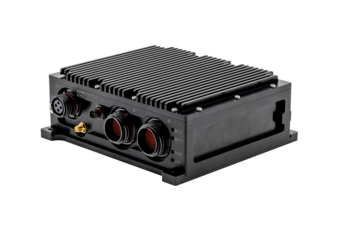
Rugged TSN Ethernet switching for deterministic embedded networks
The MIL-10TSN is part of our SOC-E / RelyUm deterministic Ethernet portfolio for embedded networks requiring controlled timing, redundancy and rugged Ethernet connectivity.
The MIL-10TSN supports up to 26 configurable Time-Sensitive Networking ports. Depending on the selected configuration, it can provide up to 22 10/100/1000BASE-T copper interfaces and up to 6 1GbE/10GbE fibre interfaces, plus one 10/100/1000BASE-T service port.
The main difference from the MIL-TSN is fibre speed: MIL-TSN supports 1GbE, while MIL-10TSN also supports 10GbE fibre connectivity.
IEEE 802.1 TSN traffic management
The MIL-10TSN supports the key mechanisms required for Time-Sensitive Networking:
- IEEE 802.1AS – Timing and Synchronization;
- IEEE 802.1Qav – Credit Based Shaper;
- IEEE 802.1Qbv – Time Aware Shaper;
- IEEE 802.1Qci – Per-Stream Filtering and Policing;
- IEEE 802.1CB – Frame Replication and Elimination for Reliability;
- IEEE 802.1Qcc – Stream Reservation Protocol enhancements.
IEEE 802.1Qbv provides time-aware transmission scheduling, while Qav controls selected traffic classes and Qci applies filtering and policing on a per-stream basis.
FRER provides frame replication and duplicate elimination for selected traffic and is combined with MSTP to support network redundancy.
For additional technical background, see the ECRIN Systems guide to Time-Sensitive Networking and its comparison with AFDX.
IEEE 802.1AS timing synchronization
IEEE 802.1AS provides the core timing and synchronization mechanism within the MIL-10TSN.
Optional Grand Master, time-server and clock-bridging capabilities can also be integrated depending on the selected configuration. A PPS output and two GPIO/PPS lines are available for additional timing interfaces.
These capabilities are particularly relevant to Information & Communication Systems combining distributed embedded computers, sensors and communication equipment.
Layer 2 Ethernet networking
In addition to TSN functions, the MIL-10TSN provides a comprehensive Layer 2 feature set including:
- IEEE 802.1Q VLANs, up to 4K VLAN groups;
- IEEE 802.1p QoS / Class of Service;
- IEEE 802.1AB LLDP;
- port rate limiting;
- storm control;
- multicast filtering;
- IGMP Snooping with up to 1024 filters;
- STP, RSTP and MSTP.
Reconfigurable MPSoC and edge computing
The system is based on a Xilinx UltraScale+ MPSoC integrating four 64-bit Arm Cortex-A53 cores, two Arm Cortex-R5F cores, an Arm Mali GPU and a 16 nm UltraScale+ FPGA.
Processing resources include up to 4 GB DDR4, 32 GB eMMC and 512 Mb QSPI Flash.
User-defined edge applications can run directly on the platform. DDS and MQTT are supported within a KVM virtual machine, together with support for the OMG DDS Extension for TSN.
Optional CAN 2.0 and RS-232/RS-422/RS-485 interfaces can also be integrated. The reconfigurable platform can support evolving TSN profiles, including requirements associated with IEEE 802.1DP.
Integrated network cybersecurity
Depending on model and configuration, cybersecurity functions include:
- IEEE 802.1X;
- IEEE 802.1AE MACsec;
- RADIUS;
- LDAP;
- RBAC;
- selective port disabling;
- HTTPS;
- SSHv2;
- TPM 2.0;
- Secure Boot;
- encrypted, authenticated and digitally signed firmware and FPGA bitstreams.
Optional functions derived from the MIL-SSR / MIL-10SSR family include VPN, stateful-inspection firewall and IPS/IDS.
These capabilities address networking requirements found in Defense, Aerospace & Security applications.
HTTPS, SSH, SNMP and NETCONF/YANG management
System configuration and monitoring can be performed through an HTTPS web interface or SSHv2 CLI.
The MIL-10TSN also supports SNMP v1/v2c/v3 and NETCONF with YANG models, with optional SNMP over TLS.
Built-In Test capabilities include PBIT, CBIT and IBIT, together with internal logging, Syslog and per-port statistics.
Fanless IP66 enclosure and MIL-DTL-38999 connectivity
The fanless enclosure measures 220 × 155 × 98 mm and weighs approximately 3 kg.
Copper, fibre, power and miscellaneous interfaces use MIL-DTL-38999 connectors, while the service interface can use either RJ45 or D38999.
Nominal input is 28 VDC, with other power-supply options available on request. Power consumption is 20–35 W, and the enclosure is rated IP66.
Military and environmental qualifications
The MIL-10TSN covers the following qualification and certification references:
MIL-STD-461
CE101, CE102, CS101, CS114, CS115, CS116, RE101, RE102, RS101 and RS103.
MIL-STD-810
Methods 500.5, 501.5, 502.5, 504.1, 506.5, 507.4, 508.6, 509.5, 513.6, 514.6 and 516.6.
Power
MIL-STD-704F and MIL-STD-1275E.
Additional references include RTCA DO-160 Section 22, EN 61000-4-2, MIL-DTL-38999, MIL-STD-1474D and IP66.
The system is also specified as DO-254 / DO-178 DAL-D certifiable.
From a TSN switch to a complete embedded network
Selecting a deterministic Ethernet switch requires system-level consideration of port count, copper/fibre media, 1/10GbE bandwidth, TSN profiles, timing, redundancy, cybersecurity, power and environmental constraints.
The wider SOC-E deterministic networking portfolio provides several ways to integrate TSN networking, from rugged standalone switches to XMC-based solutions.
ECRIN Systems can integrate the MIL-10TSN with embedded computers, servers, FPGA processing and communication equipment. Production and system integration can address the complete platform rather than individual components in isolation.